The Conditional Column: How UK Media Funders Audit a Match-Funding Pledge
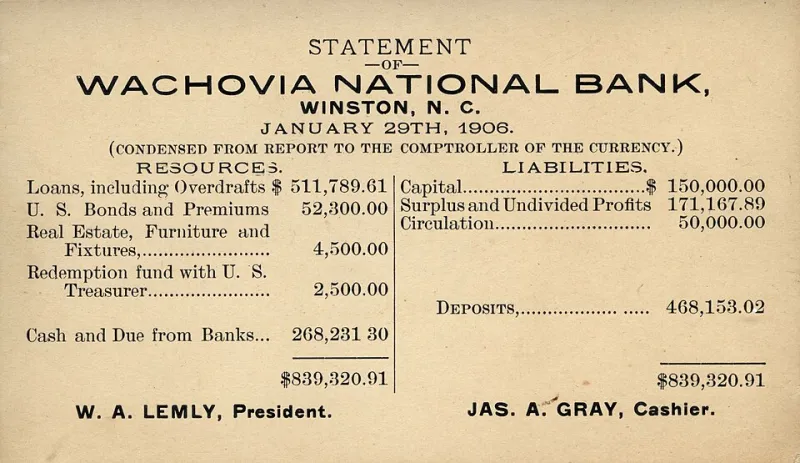
Photo: Wachovia National Bank, Winston, NC, Public domain, via Wikimedia Commons
Match funding occupies an uncomfortable place in UK media finance. It is often the difference between a competitive application and a refused one, yet it is also the element of the funding stack most likely to be described in hopeful rather than evidential terms. A producer may know that a distributor intends to pre-buy, that a director will defer a fee, or that a parent company will advance a loan. The funder, reading a spreadsheet at a distance, sees only a number and a name.
In 2026, assessors are less willing to accept the number at face value. The shift is not a sudden hostility to match funding; it is a demand for precision. Public and charitable funders face their own scrutiny, and private investors increasingly expect the grants they sit alongside to be built on verified commitments. The result is that the evidence pack around a match-funding line now matters almost as much as the line itself.
What 'Committed' Means to a Funder
Funders tend to sort match funding into three broad states: confirmed, conditional and contingent. Confirmed money is in an account or under an executed agreement with no outstanding conditions precedent. Conditional money is promised subject to defined tests — a signed co-production agreement, a satisfactory chain of title, a board resolution — that the funder can see and assess. Contingent money depends on events outside the applicant's control, such as a future tax credit assessment, a further grant round, or a sales estimate.
The mistake many applications make is to present all three in the same typeface. A pledge letter that says 'we are minded to support' is not the same as a term sheet that says 'subject to contract'. A director's loan discussed at a kitchen table is not the same as a board minute. Funders are not looking for certainty where none exists; they are looking for honest classification. An application that labels a contribution as conditional, and explains the condition, is stronger than one that overstates it and invites doubt.
The Conditional Pledge Letter: What It Should Contain
A conditional pledge letter is often the most useful piece of evidence a producer can obtain. It should be on the contributor's letterhead, signed by someone with authority, and state the amount, the purpose, the timing of payment, and the conditions that remain outstanding. It should also identify the bank or legal entity from which the funds will come. Vague language — 'support in principle', 'anticipated investment' — gives an assessor nothing to test.
Where a contributor is a related party, the letter needs more, not less, detail. A director's loan, a contribution from a parent company, or an in-kind commitment from a connected supplier will be scrutinised for double counting and for realism. The funder will want to know whether the money is genuinely additional, whether it is repayable, and on what terms. A loan is not the same as equity, and deferred fees are not the same as cash. Each should appear as a distinct line, with its own evidence, rather than being folded into a general 'other funding' total.
The Timing Gap Between Award and Drawdown
Even a well-evidenced match-funding line can fail at the drawdown stage. Funders increasingly ask not only whether the money exists but whether it will be available when the grant is claimed. A pledge dated for the end of the production schedule may be useless if the funder releases its own money against early costs. A tax credit that will not be certified until after delivery cannot fund pre-production.
The practical answer is a drawdown schedule. Map each funding source to the cost period it is intended to cover, and show the dates on which cash is expected. Where there is a gap, identify the bridging arrangement — an overdraft, a short-term loan, a deferred fee — and evidence it. Funders do not expect every source to arrive on day one, but they do expect the applicant to know the difference between a timing gap and a funding gap.
Testing the Claim Before the Assessor Does
A useful discipline is to ask, for each match-funding line, what would happen if the funder requested the money next month. Would the contributor sign the agreement? Would the board approve the loan? Would the pre-sale contract be executed? If the answer is no, the line is not confirmed, and the application should say so.
This test also helps with overstatement. Producers sometimes inflate match funding because they fear that a smaller number will weaken the application. In practice, a realistic total with clear evidence is more persuasive than a larger total that collapses under questioning. Funders assess credibility as well as capacity. A budget that is fully funded on paper but thinly evidenced invites a request for further information, a delay, or a refusal.
Presenting the Evidence
Keep the funding stack in a single table, with columns for source, amount, status, evidence, and expected date. Put the letters and resolutions in an annex, numbered to match the table. In the narrative, explain the conditions in plain English rather than leaving the assessor to infer them. If a contribution is in kind, state its basis of valuation. If it is a loan, state the repayment terms. If it is contingent on another grant, say so and give the decision date.
The aim is not to eliminate uncertainty but to make it legible. A funder that can see exactly what is committed, what is conditional, and what is still at risk is in a better position to support an application than one that is asked to take a total on trust.
Match funding is a means, not a virtue. The funders who provide it, and the assessors who test it, are looking for a coherent stack rather than an impressive number. In 2026, the strongest applications are likely to be those that distinguish clearly between cash in hand and cash in prospect, and that show the funder precisely where each contribution sits in the schedule. That is a less glamorous exercise than building a headline budget, but it is the one that survives due diligence.